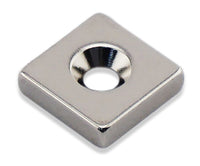
NEODYMIUM MAGNETS
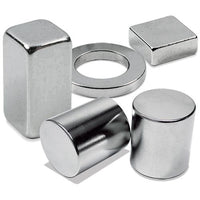
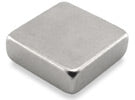
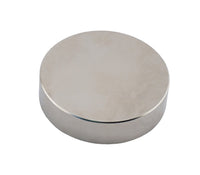
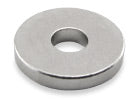
Neodymium magnets (Nd-Fe-B) are composed of neodymium, iron, boron and a few transition metals. These magnets are extremely strong for their small size, metallic in appearance and found in simple shapes such as rings, blocks and discs. Not sure if Neodymium is the best material for your application? Click here for an attribute and application comparison for all of the magnetic materials we offer.
Choose from one of the following shapes:
- Applications
- Attributes
- Tolerances
- Machining
- Magnetizing & Handling
- Magnetic & Physical Properties
- Compare & Contrast
Applications of Neodymium Magnets
|
|
|
Attributes of Neodymium Material
|
|
Tolerances
For as pressed material, tolerance on the thickness (direction of magnetization) is ± .005. Other dimensions are ± 2.5% or ± .010, whichever is greater. According to IMA standards, visual imperfections such as hairline cracks, porosity and minor chips are commonly found in sintered metallic magnets. A chipped edge is considered acceptable if no more than 10% of the surface is missing. Cracks are acceptable as long as they do not extend across more than 50% of pole surface.
Machining
Since neodymium magnet material is prone to chipping and cracking, it does not lend itself to conventional machining methods. However, neodymium can be abrasively ground, but only with the use of liberal amounts of coolant. The coolant minimizes heat fracturing and the risk of fires caused by oxidized grinding dust.
Magnetizing and Handling
Neodymium magnets are very brittle and very strong magnetically. Therefore, it is crucial to handle these magnets with extreme care to avoid personal injury and damage to the magnets. Fingers can be severely pinched between attracting magnets. Magnets can chip if allowed to “jump at” an attracting object. It is highly recommended that when constructing rare earth magnetic assemblies, they be magnetized after assembly.
Typical Magnetic and Physical Properties of Neodymium Magnet Material |
||||||||||
| Magnetic Material |
Density |
Max. Energy Product BH (max) |
Residual Induction BR |
Coercive Force HC |
Intrinsic Coercive Force HC |
Normal Maximum Operating Temp. |
Curie Temp. |
|||
lbs/in |
g/cm |
MGO |
Gauss |
Oersteds |
Oersteds |
Fº |
Cº |
Fº |
Cº |
|
| Neodymium 27SH | 0.267 |
7.4 |
27.0 |
10800 |
9800 |
20000 |
302 |
150 |
644 |
340 |
| Neodymium 30H | 0.267 |
7.4 |
30.0 |
11000 |
10500 |
17000 |
248 |
120 |
626 |
330 |
| Neodymium 35 | 0.267 |
7.4 |
35.0 |
12300 |
10500 |
12000 |
176 |
80 |
593.6 |
312 |
| Neodymium 40 | 0.267 |
7.4 |
40.0 |
12900 |
10500 |
12000 |
176 |
80 |
593.6 |
312 |
| Neodymium 42 | 0.267 |
7.4 |
42.0 |
13000 |
9500 |
11140 |
176 |
80 |
593.6 |
312 |
| Neodymium 45 | 0.267 |
7.4 |
45.0 |
13500 |
11000 |
12000 |
176 |
80 |
593.6 |
312 |
| Since many combinations of elements and orientations are possible, additional grades are available. | ||||||||||
Compare and Contrast Magnetic Applications and Materials
Applications of Neodymium Magnets
|
Attributes of Neodymium Material
|
Applications of Ceramic Magnets
|
Attributes of Ceramic Material
|
Applications of Samarium Cobalt Magnets
|
Attributes of Samarium Cobalt Material
|
Applications of Alnico Magnets
|
Attributes of Cast Alnico
Attributes of Sintered Alnico
Attributes of Both Cast and Sintered Alnico
|